


Promoted
Jev AI Model
freemiumJev AI Model pairs a free playground with an API for turning text or JSON state into typed classifications, scores, and yes/no probability outputs.
AIDeveloper ToolAnalytics
What it does, who it helps, and how it fits into your workflow.
Jev AI Model is presented as an independent web resource for exploring Jev, a decision model aimed at software workflows. Its homepage explicitly says it is not affiliated with or endorsed by TypeSafe AI. The site combines an interactive playground, API documentation, and one-time credit plans for developers who want structured answers inside their own application.
The documented flow starts with a state, such as a support ticket or a JSON record, and one or more questions about that state. Choice returns a selected option with probabilities, Score rates a state against ordered levels, and Noul represents a yes-or-no judgment as a probability. The answers use the same question identifiers as the request, so application code can map each result to its own routing or review logic.
The homepage describes the playground as free with unlimited runs. For programmatic use, the documentation describes an API key and a REST endpoint on jevaimodel.dev. The site says Jev can accept text, JSON objects, and arrays of text; it does not accept image, audio, or video input. This is a bounded decision interface, not a substitute for application permissions, deterministic policy, or human approval.
Choice is for classification or routing among options, Score is for a rating rubric, and Noul is for a yes-or-no judgment. The documentation says Score uses an ordered set of two to ten levels and returns a probability-weighted score. Choice and Score responses also include confidence derived from their probability distributions.
Several questions can use the same state in one request. This lets a developer ask about intent, urgency, and escalation together instead of chaining calls solely to split a task. The site recommends keeping questions well scoped and using thresholds or a human-review path for higher-risk decisions.
The public interface displays an example state, configurable questions, and a sample result. The docs then show how to create a key and send a request to https://jevaimodel.dev/v1/systemone. The API returns structured answers keyed by question ID, along with usage fields; the documented elapsed time includes validation and should not be read as pure model inference time.
/v1/systemone endpoint. Your application should decide what actions follow.These use cases follow the site's examples; no custom task, benchmark, or production integration was tested.
The site advertises free, unlimited browser-playground runs. API credit packs are one-time purchases: Starter is $10 for 100,000 credits, Pro is $100 for 1,000,000 credits, and Enterprise is $1,000 for 11,000,000 credits, with the Enterprise pack described as including 10% extra credits. Credits do not expire according to the pricing page, and purchases do not auto-renew. Workspaces, concurrency, speed, and support differ by tier. Verify current checkout terms before purchase. Pricing was checked on 2026-09-25.
Strengths
Limitations
Choose Jev AI Model when you want the site’s free playground and its documented endpoint for structured Jev decisions. For direct provider access, compare the TypeSafe AI API documentation and confirm its current access, pricing, and terms. A general text-generation API may be a better fit when the application needs open-ended prose instead of bounded classifications or scores. No head-to-head performance comparison was performed.
The site says it is an independent resource and is not affiliated with or endorsed by TypeSafe AI.
The homepage advertises unlimited free playground runs. The pricing page lists separate one-time credit packs for API usage.
The docs list text, JSON objects, and arrays of text. They say images, audio, and video are not supported.
No. The docs describe them as signals, not guarantees. Keep appropriate thresholds, deterministic checks, and human review in the application.
Jev AI Model pairs a free playground with an API for turning text or JSON state into typed classifications, scores, and yes/no probability outputs.
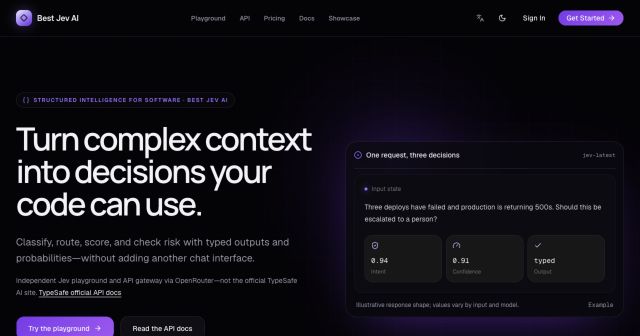
Best Jev AI pairs a free playground with an OpenRouter gateway for turning text or JSON context into typed choices, scores, and yes/no probabilities.

Browse Rush Ounza’s public software-engineering portfolio, including machine-learning notebooks, web projects, activities, and background.