


Promoted
Jev AI Model
freemiumJev AI Model pairs a free playground with an API for turning text or JSON state into typed classifications, scores, and yes/no probability outputs.
AIDeveloper ToolAnalytics
What it does, who it helps, and how it fits into your workflow.
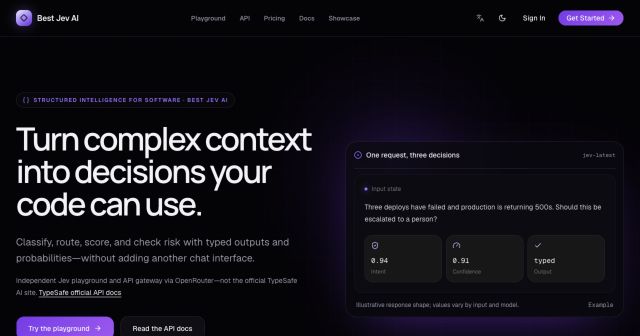
Best Jev AI presents a browser playground and an independent API gateway for using TypeSafe AI's Jev decision model. Its site says the gateway routes requests through OpenRouter and is not the official TypeSafe AI service. Jev is aimed at software teams that need a model to return a bounded decision for application code, rather than a long conversational answer.
An application supplies a shared state as text, a JSON object, or an array of text, then asks one or more typed questions. The documented question types are Choice for selecting among named options, Score for rating against an ordered rubric, and Noul for a yes-or-no judgment expressed as a probability. The response includes structured answers and probability-related fields that code can inspect before taking its own next step.
The public playground is described as free with unlimited runs. The API documentation describes a separate authenticated workflow: create a key, send a request to the site's /v1/systemone endpoint, and handle the typed response. The product is therefore best understood as an independent Jev gateway with a learning interface, not as an official TypeSafe product or a general-purpose chat application.
Choice maps a question to options supplied by the developer; Score rates a state on an ordered scale; Noul estimates the probability that a statement is true. Defining the output shape before inference makes the result easier to route or store. The model's probabilities and confidence are signals, not proof that a decision is correct.
The playground describes up to eight questions against the same state. This can combine tasks such as intent classification, urgency detection, and risk scoring without constructing a separate prompt for each question. Each question should remain specific and well scoped so the application can interpret its answer.
The playground shows the input and question configuration alongside an illustrative typed result. The independent gateway documents a REST endpoint and an API-key flow for developers who want to connect the same decision pattern to their own service. The Best Jev AI site specifically says it routes Jev requests through OpenRouter.
https://bestjevai.com/v1/systemone. Route, approve, or reject actions in application code; the model does not replace those controls.These are examples consistent with the published workflow; no production benchmark or accuracy result was verified.
The site advertises unlimited runs in its browser playground at no charge. Its API pricing page offers one-time credit packs: Starter is $10 for 100,000 credits, Pro is $100 for 1,000,000 credits, and Enterprise is $1,000 for 11,000,000 credits, including a stated 10% extra. The listed credits do not expire, and the plans do not auto-renew. Workspace count, concurrency, support, and speed vary by pack. Confirm the current terms and checkout details before buying. Pricing was checked on 2026-09-25.
Strengths
Limitations
Choose Best Jev AI when you want to inspect Jev's typed decision pattern in a browser and use this site's independent OpenRouter gateway. If you need a direct provider relationship, compare the TypeSafe AI API documentation and its current access requirements. If the task is open-ended writing rather than a bounded choice, score, or yes-or-no decision, a general text-generation API may fit better. These are workflow distinctions, not benchmarked comparisons; verify provider terms and model behavior for your use case.
No. Best Jev AI describes itself as independent and says it is not the official TypeSafe AI site. It says its Jev gateway routes through OpenRouter.
The site advertises unlimited free playground runs. Its API page separately lists paid one-time credit packs.
The docs list text, JSON objects, and arrays of text. They state that image, audio, and video inputs are not supported.
No. The documentation says probabilities and confidence are signals rather than guarantees; applications should set thresholds and retain human review where needed.
Jev AI Model pairs a free playground with an API for turning text or JSON state into typed classifications, scores, and yes/no probability outputs.
Best Jev AI pairs a free playground with an OpenRouter gateway for turning text or JSON context into typed choices, scores, and yes/no probabilities.

Browse Rush Ounza’s public software-engineering portfolio, including machine-learning notebooks, web projects, activities, and background.