

Promoted
Jev AI Model
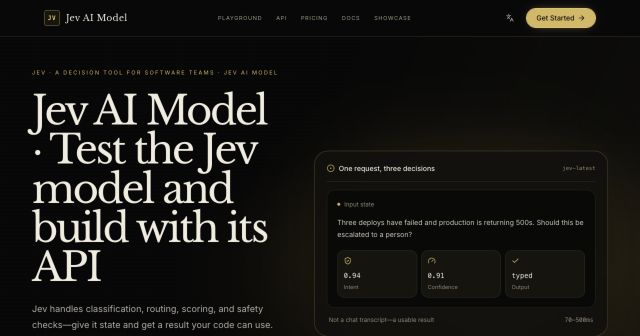
freemiumJev AI Model pairs a free playground with an API for turning text or JSON state into typed classifications, scores, and yes/no probability outputs.
AIDeveloper ToolAnalytics
What it does, who it helps, and how it fits into your workflow.
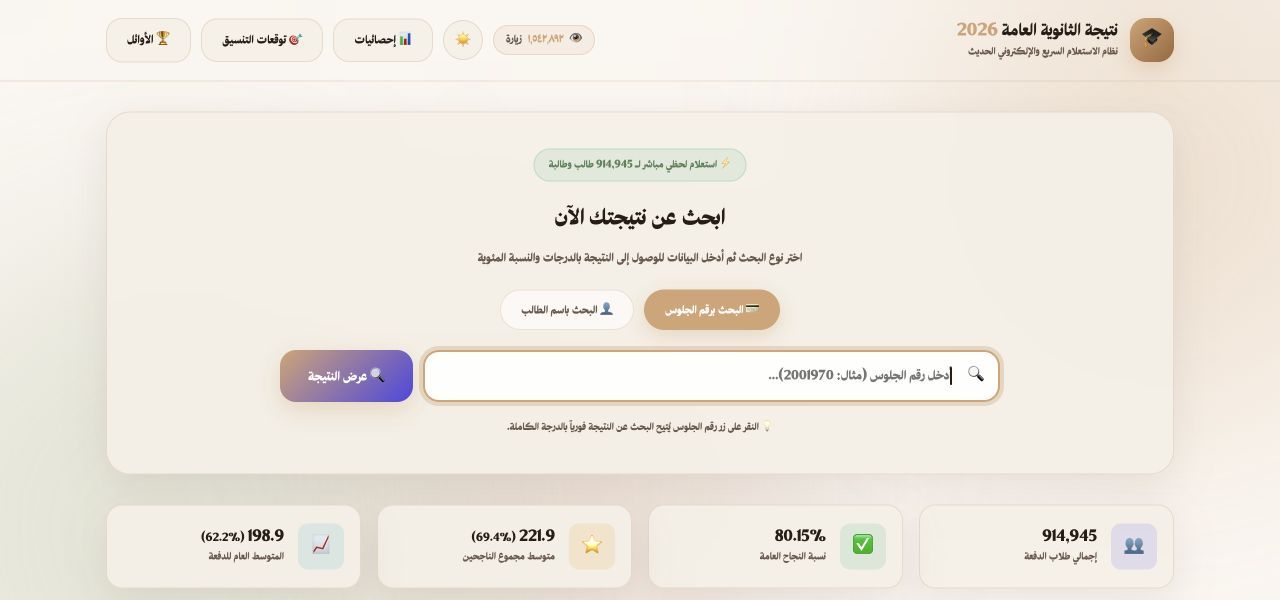
natiga thanawy vercel app is an Arabic-language website for exploring Egyptian secondary-school results and estimated college admission thresholds. The supplied Vercel address redirected to a similarly named Cloudflare Workers site during our review. Its interface combines student-result search, aggregate statistics, and a college prediction table rather than offering a general-purpose AI assistant.
The most useful workflow we could test without accessing a student's personal records was manual-score prediction. A visitor supplies a hypothetical score and academic track, then receives groups of colleges that the site's model places within reach, near the threshold, or above that score. These are advisory outputs, not admission decisions. The site's own disclaimer identifies the application as unofficial.
The pages use different cohort years and totals, so their data should be interpreted cautiously. We verified visible controls and one prediction workflow, not the accuracy, completeness, or official provenance of the underlying records.
The homepage offers search by examination seat number or student name. It describes a result containing marks and percentages. We inspected the search interface but did not retrieve a real student's record, test name matching, or verify result-card printing and sharing. Visitors should avoid submitting anyone else's identifiers without permission.
The predictions page can switch from seat-number lookup to manual entry. In our test, entering the fictional score 250 out of 320 and selecting the science track produced groups of 628 available options, 21 near-threshold options, and 262 higher-score options. These numbers describe the application's response during this test, not an independently verified set of eligible admissions choices.
The populated table shows college or institute names, academic tracks, a column labelled 2025 scores, estimated 2026 scores, changes in points, and percentages. Search, sector filters, sorting controls, and pagination are present. The manual-score calculation changed the table, but every filter and page was not separately tested.
The analytics page displays pass, second-round, and failure counts, score bands, and summaries for science, mathematics, and literary tracks. Its labels refer to 2025 while another section discusses 2026 estimates. The page loaded numerical summaries successfully; we did not audit the dataset or reproduce its calculations.
It is not suitable as the sole source of an official result, verified eligibility decision, or application deadline. No user-facing AI capability was independently established in this review.
The manual-score prediction workflow and aggregate statistics were accessible without an account, payment, or trial activation on 2026-09-20. Free describes that tested access only. No separate pricing page or paid tier was observed in the inspected navigation. We did not verify all student-result workflows, future access conditions, or a permanent free-service commitment.
Fees appearing within college names or programmes concern educational institutions; they should not be confused with the website's own pricing.
Strengths
Limitations
Use this site for informal, hypothetical exploration if its Arabic interface and manual-score table are helpful. For confirmed results or admission decisions, use the responsible official education or admissions channel. The site's disclaimer itself directs users to official ministry announcements. We did not complete a separate comparison of competing tools and do not claim one is more accurate or comprehensive.
Its own disclaimer says it is an unofficial advisory application. A government-style topic or an official-data claim does not establish government ownership.
Yes for the tested prediction workflow: manual-score entry accepted a fictional score and track and returned a college table. We did not test whether every other feature can be used without identifiers.
No. The results are the site's estimates. Programme eligibility, official cutoffs, and application processes still require authoritative confirmation.
The differing year labels and dataset totals need clarification before relying on the results. Working interface controls are not enough to certify the underlying educational information.
Jev AI Model pairs a free playground with an API for turning text or JSON state into typed classifications, scores, and yes/no probability outputs.
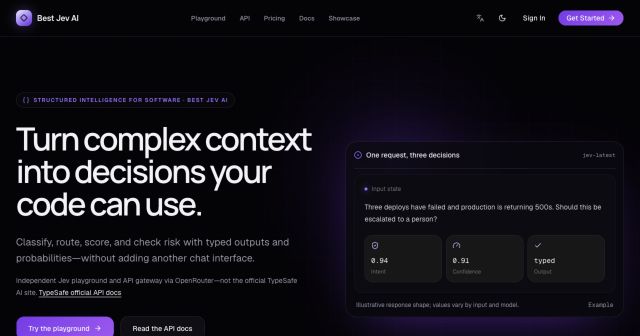
Best Jev AI pairs a free playground with an OpenRouter gateway for turning text or JSON context into typed choices, scores, and yes/no probabilities.

Browse Rush Ounza’s public software-engineering portfolio, including machine-learning notebooks, web projects, activities, and background.