

Promoted
Jev AI Model
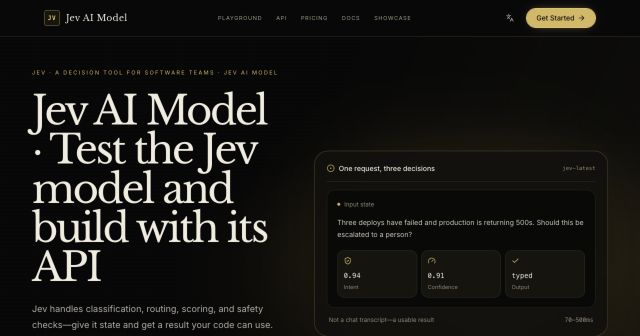
freemiumJev AI Model pairs a free playground with an API for turning text or JSON state into typed classifications, scores, and yes/no probability outputs.
AIDeveloper ToolAnalytics
What it does, who it helps, and how it fits into your workflow.
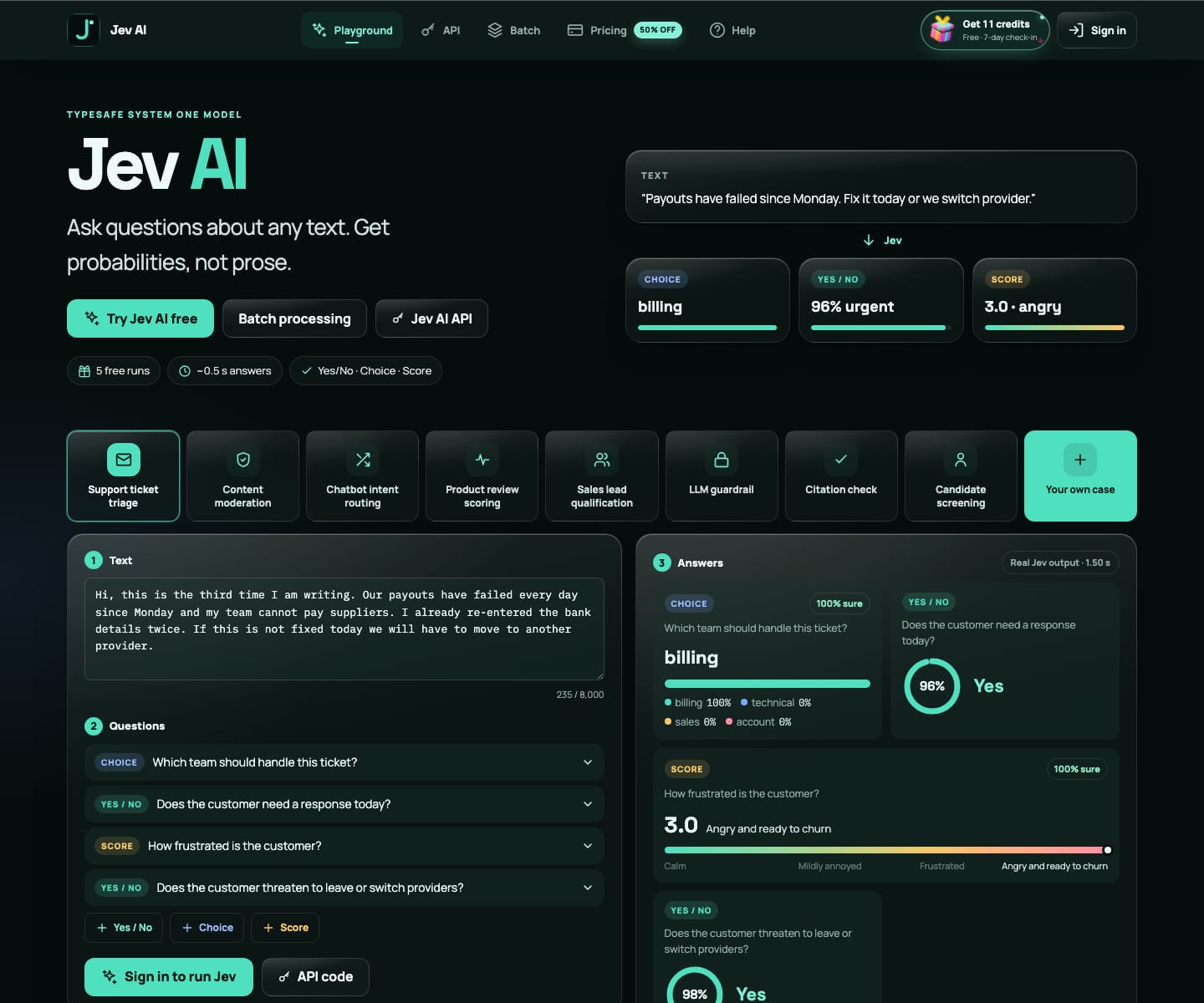
Jev AI is an independently operated workspace for accessing Jev, the System One model developed by TypeSafe. It provides a browser playground, batch tooling, account-based credits, and a hosted API endpoint. Users supply text or structured JSON and ask typed questions; Jev returns yes/no probabilities, category choices, or numeric scores with confidence values rather than generated prose.
The product is aimed at decisions that software can branch on: support-ticket routing, moderation, intent classification, review scoring, lead qualification, guardrail checks, and citation support. Jev AI is not the model vendor itself. TypeSafe develops Jev, while Jev AI operates the website, accounts, billing, support, and platform connection.
/api/v1/systemone endpoint with cURL, JavaScript, or Python-style HTTP requests.Open the playground and select a demo such as support-ticket triage, content moderation, intent routing, review scoring, lead qualification, guardrail checking, citation checking, candidate screening, or a custom case. Replace the text with a string, JSON object, or array, then define the questions. A question can ask for a yes/no probability, select from labels, or score text against named levels.
After signing in, run the question set and inspect the typed answers and confidence values. The API page can generate a request from the same structure. Developers create a Jev AI key, send state, model, and questions JSON to the endpoint, and parse the answers object. Key creation and status checks do not run the model.
Jev AI is freemium. New accounts receive five free credits; welcome and daily check-in credits are used first, one per run or API call. Purchased usage bills only input tokens at one credit per million tokens, with output tokens free.
The reviewed pricing page listed annual Creator access at $114 per year for 720 million input tokens, Studio at $294 per year for 1.98 billion tokens, and Max at $588 per year for 4.752 billion tokens, each showing a 50% discount from the represented monthly-equivalent price. Unused paid tokens roll over, payment is handled by Stripe or PayPal where available, and renewal can be cancelled. Token packs and monthly options may also be available through the pricing interface; exact offers and promotional pricing can change.
Strengths
Limitations
Jev AI's comparison pages discuss Djev, SemIf, OpenJev, and Laya as related systems. Those pages are operated by Jev AI, so they are useful for understanding its positioning but are not independent evaluations. General LLM APIs can also classify text, while Jev's distinctive promise is typed output plus calibrated confidence in a System One-style request.
Choose Jev AI when an application needs repeatable labels, scores, or yes/no probabilities with a confidence threshold. Choose a generative LLM when the task requires writing, summarizing, or open-ended reasoning. Organizations already using TypeSafe's official API can compare direct TypeSafe access with Jev AI's account, billing, playground, and batch layer before selecting a deployment path.
No. TypeSafe develops Jev models. Jev AI is an independently operated platform that provides a workspace, accounts, token billing, batch tools, and API access.
No. Jev accepts text as a string, JSON object, or array. Other formats must be converted to text or structured fields first.
No. It returns structured yes/no probabilities, choices, and scores with confidence. A separate generative model is needed for prose.
Yes. New accounts receive five free credits, and the site offers daily check-in credits. Paid plans and token packs are available for continued use.
Jev AI Model pairs a free playground with an API for turning text or JSON state into typed classifications, scores, and yes/no probability outputs.
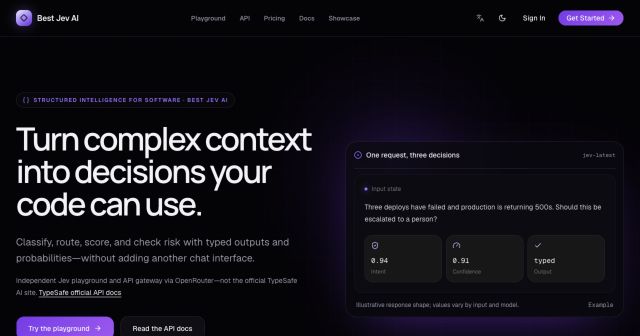
Best Jev AI pairs a free playground with an OpenRouter gateway for turning text or JSON context into typed choices, scores, and yes/no probabilities.

Browse Rush Ounza’s public software-engineering portfolio, including machine-learning notebooks, web projects, activities, and background.