


Promoted
Jev AI Model
freemiumJev AI Model pairs a free playground with an API for turning text or JSON state into typed classifications, scores, and yes/no probability outputs.
AIDeveloper ToolAnalytics

What it does, who it helps, and how it fits into your workflow.
Project Moon Life is a browser-based urban life simulation set in a City inspired by the worlds of Lobotomy Corporation and Limbus Company. A resident begins in a Nest, the Backstreets, or the Outskirts, then moves through education, work, relationships, and unexpected events. The site describes itself as an unofficial fan-made project, not an official or affiliated Project Moon game.
The free simulator uses a seeded rules engine and built-in events. Players can begin with a random resident or customize details such as a name, story language, and seed. Decisions change five fictional attributes and the life that gets saved in the browser archive. A separate paid AI chapter adds generated scenes and cloud saves.
Its clearest distinction is reproducibility: with the same rules version, seed, and choices, the site says a life can be replayed across languages and resident names. The standard mode does not require sign-in or payment. Its optional AI mode is a separate service with separate records and a one-time price.
Start with a randomly prepared resident or customize a name, story language, seed, and rules version. The seed determines the resident's starting background, including family and birthplace. Reusing the same rules version and seed gives players a repeatable starting point; keeping the choices the same reproduces the same life according to the field guide. A seed link shares the beginning, not the saved life record.
Keywords: seeded simulation, replayable life sim, character setup, shareable seed.
Standout: the documented seed-and-choice combination is designed to reproduce a run across supported story languages.
Read life events and choose how the resident responds as education, work, relationships, and career paths unfold. Five status values—health, sanity, resources, connections, and reputation—are shown as fictional indices from 0 to 100. Choices can improve one area while putting another at risk; reaching zero health or sanity ends a life. The displayed resources are fictional and cannot be traded or redeemed as money.
Keywords: urban life simulator, branching events, career paths, five life stats.
Standout: the game makes consequences visible through five tracked attributes while keeping the simulation's resources fictional.
The field guide describes four seasons per simulated year, with about one real minute per year at normal speed. Players can pause, slow the simulation, or advance it up to 32×. Keyboard controls include Space to pause, the bracket keys to adjust speed, 1–4 to select an option, and 0 to let an event pass. Major events pause for a decision; minor events can take their final option after a 15-simulated-second timer, which also pauses when the game is paused.
Keywords: browser game, pause control, simulation speed, event timer.
Standout: players can follow a life at a deliberate pace or move through uneventful years faster, while major choices still wait for input.
Free lives save in the current browser without an account. The privacy page says the names, seeds, choices, attributes, and life records are stored in browser IndexedDB and are not uploaded. Players can export a backup and import it in another browser to move devices; saves do not automatically sync. An already-loaded game can continue offline, and the guide says a hidden tab pauses the simulation.
Keywords: local browser saves, life archive, backup export, import between browsers.
Standout: the free mode keeps its life records on the player's device and provides an explicit backup path for moving them.
The separate AI chapter is presented as six chapters with recurring characters and consequences that carry forward. It requires an account and a one-time USD $10 pass; the official terms say the pass grants unlimited AI life starts while the service operates, with temporary request-rate and concurrency controls. AI lives use cloud saves and can be downloaded as records. The privacy page says fictional state and recent scenes are sent to DeepSeek, excluding the player's email and resident name. During provider outages, the terms say clearly marked original preset scenes may be used.
Keywords: AI narrative, recurring characters, remembered choices, cloud saves.
Standout: this is an optional cloud-backed story mode layered beside unlimited free local simulation, rather than a requirement for starting a basic life.
Project Moon Life is freemium. The seeded base simulator is described as free and unlimited, with no account or payment required; the number of records a player can keep is still bounded by local browser storage. The optional AI Chapter Pass costs USD $10 once, with no subscription. The official pricing and terms pages say it allows unlimited AI lives while the service operates. Temporary request-rate and concurrency controls apply. Pricing was checked on 2026-10-16.
Strengths
Limitations
/play page is marked noindex, nofollow; the main site and field guide provide more of the publicly readable product details.These are adjacent experiences, not feature-for-feature equivalents. Check each official site for current availability and terms.
The standard seeded simulator is described as free and unlimited without sign-in. The optional AI chapter costs USD $10 once. Local browser capacity can still limit how many free records a device retains.
The field guide says the same rules version, seed, and sequence of choices reproduce the same life, including across supported story languages and resident names. A seed link shares a start point, not a saved run.
Free lives are saved locally in the browser and are not uploaded according to the privacy page. The separate AI mode uses cloud saves. Export a local backup before clearing browser data or changing devices.
No. Project Moon Life identifies itself as an unofficial fan work inspired by the settings of Lobotomy Corporation and Limbus Company. The site says its artwork and event writing are original.
The site is intended for players aged 15 and older. It warns that fictional death, illness, crime, and psychological distress may appear. Choices, stats, and outcomes are fiction, not advice.
Jev AI Model pairs a free playground with an API for turning text or JSON state into typed classifications, scores, and yes/no probability outputs.
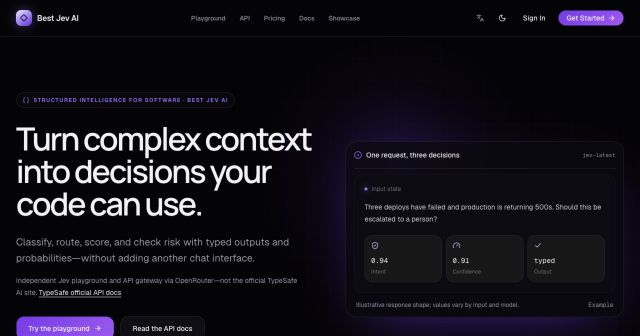
Best Jev AI pairs a free playground with an OpenRouter gateway for turning text or JSON context into typed choices, scores, and yes/no probabilities.

Browse Rush Ounza’s public software-engineering portfolio, including machine-learning notebooks, web projects, activities, and background.